Apr 16, 2026
How to clean a solar panel without damaging it: a simple and safe guide
From choosing the right water to avoiding the most common mistakes: everything needed to clean solar panels effectively, gently, and without risk.
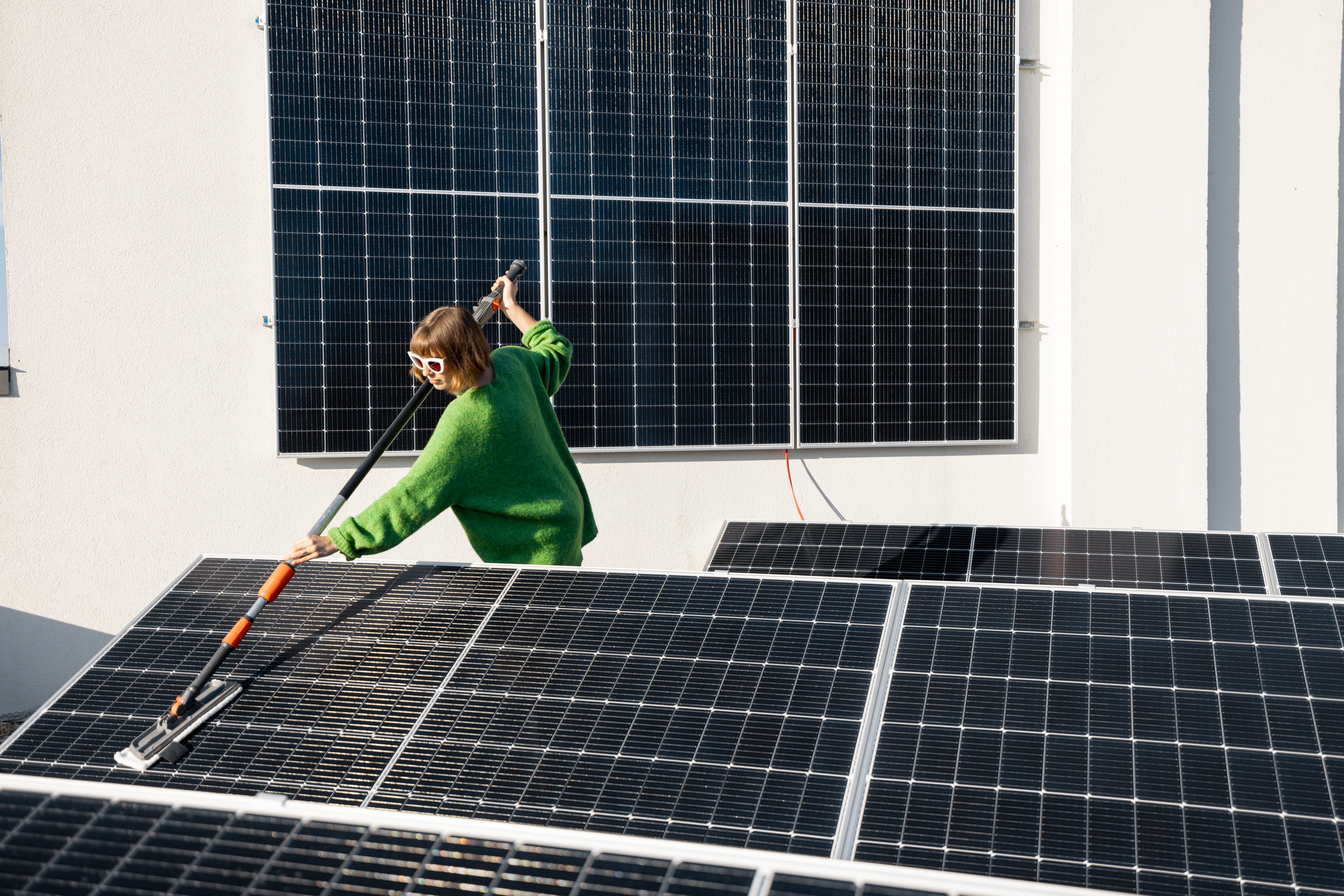
Cleaning a solar panel may seem like a simple task. At first glance, it might appear enough to remove dust and dirt from the surface, much like cleaning a pane of glass exposed to the elements. In reality, it is not quite that simple. A solar panel is designed to withstand rain, wind, temperature fluctuations, and weather exposure, but that does not mean it can be treated carelessly.
Here is the point: cleaning a solar panel without damaging it is absolutely possible, but it is necessary to know how to do it properly. Incorrect cleaning, using unsuitable tools or working at the wrong time of day, can cause streaks, surface marks, limescale residue or, even worse, small forms of damage that may compromise the quality of the outer surface over time.
On the other hand, ignoring the issue altogether is not always the best option. Dust, leaves, pollen, smog, sand, or organic residue can build up on the modules and gradually reduce the amount of light reaching the cells. This does not always lead to an immediate drop in performance, of course. However, over time, a persistent layer of dirt can affect the system’s efficiency.
That is why it is worth approaching the topic in a practical way, without alarmism but also without improvisation. The goal is not to clean the panels at all costs, but to clean them properly. In this guide, we will look at how to clean a solar panel without damaging it, which tools to choose, which mistakes to avoid, when DIY cleaning may be acceptable, and when it makes more sense to leave the job to a professional.
Why cleaning a solar panel matters
Cleaning solar panels is not an aesthetic issue. It is not about having a tidier or more visually appealing system, but about maintaining favourable conditions for proper operation over time.
How dirt, dust, and residue reduce solar panel efficiency
A solar module works by using sunlight that passes through the outer surface and reaches the cells. When dust, sand, leaves, smog residue, pollen, or other deposits build up on the glass, part of that light is blocked. The result is fairly intuitive: if less light gets through, the panel operates under less favourable conditions.
Naturally, a light layer of dust is not enough to seriously compromise a system. Much depends on the context. A system installed in a clean, well-exposed area may require very little intervention, while a system near busy roads, agricultural areas, dusty environments, or coastal locations may get dirty more quickly and more heavily.
In short, dirt does not always have the same impact. But when it becomes clearly visible, ignoring it is not a particularly smart choice.
Why poor solar panel cleaning can cause damage
This is where the more delicate side of the subject comes in. While dirt can reduce efficiency, incorrect cleaning can create even bigger problems.
Abrasive materials, harsh detergents, overly strong water jets, or excessive scrubbing can leave marks, scratches, or residues that are difficult to remove. Even an apparently harmless action, such as rubbing a layer of dust mixed with sand using the wrong sponge, can create friction and damage the surface.
In other words, the panel must be cleaned intelligently. The aim is not to make it look brand new through aggressive cleaning, but to remove dirt without causing damage.
The difference between solar panel cleaning and system maintenance
There is a fairly common misunderstanding: thinking that cleaning and maintenance are the same thing. They are not.
Cleaning concerns the removal of dirt and residue from the external part of the panel. Maintenance, on the other hand, includes broader checks: the overall condition of the system, technical inspections, performance monitoring, and component checks.
Put simply: cleaning the panel is useful, but it does not replace a more complete system inspection. It is part of the overall care, not the entire job.
When it makes sense to clean a solar panel
One of the most common questions is also one of the most sensible: when is it actually necessary to intervene? The answer depends on several factors, but a few practical criteria can help.
The signs that indicate solar panels need cleaning
The first sign is often visual. If there are obvious accumulations of dust, persistent marks, leaves, bird droppings, or deposits that do not disappear even after rain, then cleaning may be appropriate.
There are also times when it is worth carrying out a closer inspection: after long dry periods, after particularly windy days, during seasons with a lot of pollen, or in environments where sand and smog accumulate easily. There is no need to rush to clean the panels at the first speck of dirt, but there is also no reason to wait until the panel looks completely different.
How often solar panels should be cleaned in a residential system
For an average residential system, the most sensible approach is to combine periodic cleaning with regular visual inspections. There is no need to turn cleaning into an obsessive routine. In many cases, it is enough to observe the condition of the modules consistently and intervene only when it is really necessary.
In many situations, rain helps keep the surface reasonably clean, especially if the panels are installed at a good angle. However, rain is not always enough. Some residues remain, others stick more firmly to the surface, and some build up in specific areas. That is why visual inspection remains a good habit.
In which environmental conditions more frequent cleaning is needed
Some systems, due to their location and surroundings, tend to get dirty more quickly. This happens in areas close to the sea, in agricultural zones, in environments with a lot of pollen, in dusty settings, or near busy roads.
Even proximity to roofs or surfaces from which dust, leaves, or small debris may fall can increase dirt build-up on the modules. In situations like these, more frequent cleaning can be useful to keep the panels in better condition.
How to clean a solar panel without damaging it: basic rules to follow
Before even discussing the procedure, it is worth establishing a few basic rules. They are simple, but they really make a difference.
Choose the right moment to clean solar panels
One of the most common mistakes is cleaning during the hottest hours of the day, perhaps around midday when the sun is strongest. That is a bad idea. A very hot panel should not be cleaned at that time, both to avoid thermal shock and to prevent the water from evaporating immediately and leaving streaks and residue behind.
In general, the best time is early morning or evening, when the surface is cooler and cleaning can be done more calmly.
Clean only cool modules and never when they are overheated
This point deserves separate emphasis: the module must be cool, or at least not overheated. Pouring water onto a very hot surface is not good practice. It is better to wait and work when the panel temperature is more manageable.
Avoid scratches, streaks, and residue while washing the solar panel
Cleaning properly does not mean scrubbing hard. In fact, the opposite is often true. It is necessary to move gently, avoid excessive pressure, and not drag coarse dirt across the surface.
Likewise, attention must be paid to the water being used and to any residue it may leave behind. A poorly cleaned panel may look clean at first glance, yet still remain marked by streaks or mineral deposits.
Roof safety and access to the panels: what to assess before starting
Safety comes first. Always. If the panels are difficult to reach, if the roof is sloped, if the position is awkward, or if there are no safe working conditions, DIY cleaning should be ruled out.
This may sound obvious, but it is not. No cleaning task is worth the risk of a fall. If access is not simple and safe, it is better to stop there.
What to use to clean solar panels
Now for the practical part: the tools. Here too, there is no need for complicated solutions. It is simply a matter of using the right things.
Clean water or demineralised water for solar panels: which one to choose
In most cases, water is enough. The point is which water to use. If the available water is very hard, it may leave streaks or residue once dry. That is why demineralised water is often a more suitable choice, because it reduces the risk of deposits.
This does not mean tap water should always be excluded. But if it is hard or rich in limescale, that should be taken into account and a more suitable solution considered.
Microfibre cloths, soft sponges, and telescopic poles for gentle cleaning
The best tools are soft ones. Clean microfibre cloths, gentle sponges, and, when needed, telescopic poles with suitable heads allow the surface to be cleaned without being aggressive.
The logic is very simple: everything that touches the panel must be clean, gentle, and non-abrasive. If a tool would scratch glass, it is probably not suitable here either.
Useful tools for cleaning solar panels without damaging the glass
In addition to water and soft cloths, buckets, controlled water distribution systems, and accessories that help reach the modules without applying too much pressure can also be useful.
There is no need for highly specialised equipment. Often, very little is needed, as long as it is suitable and used properly.
What should never be used to clean a solar panel
Knowing what to avoid is just as important as knowing what to use.
Why harsh detergents and unsuitable chemicals should be avoided
Very strong detergents are almost never necessary. They may leave residues, alter the surface, or simply be unnecessarily aggressive. In most cases, gentle cleaning is more than enough.
When there is a temptation to use something stronger, that is often the moment when the wrong method is getting closer.
Abrasive sponges, scrapers, and rigid tools: the risks for the panel surface
Here the main risk is clear: scratching. A dirty surface should never be treated with abrasive, metal, or rigid tools. Even small repeated marks over time can worsen the quality of the surface.
Dirt should be removed methodically, not attacked as if cleaning a floor.
Why a pressure washer is not suitable for cleaning solar panels
A pressure washer may seem like the perfect shortcut: fast, powerful, apparently effective. In reality, it is not the right choice. High pressure is not consistent with gentle cleaning and may be too aggressive for this type of surface.
In this case, doing it harder does not mean doing it better.
The correct procedure: how to clean solar panels step by step
Once the principles and tools are clear, it is possible to move on to the practical steps.
Check the solar panel and remove leaves, dust, and surface dirt
The first step is to inspect the panel carefully. Before wetting everything, it is best to remove the most obvious residue, such as dry leaves or light deposits, so that they are not dragged across the surface.
This must be done gently. No rushing, no abrupt movements.
Wet the surface gently without using water jets that are too strong
Once the most visible dirt has been removed, the panel can be wetted calmly. The water helps dissolve and soften the residue, preparing the surface for the actual cleaning.
The same rule applies here as well: no excessive pressure.
Clean the solar module with light movements and without excessive pressure
Using a soft cloth or gentle sponge, the cleaning can begin. The movements should be light and steady, without scrubbing hard. If the dirt does not come off immediately, it is better to continue patiently rather than increasing the pressure.
A properly done cleaning job is almost always a calm one.
Rinse thoroughly to avoid limescale, streaks, and residue
After the dirt has been removed, rinsing is important. It helps remove any remaining residue and reduces the risk of streaks or mineral traces on the surface.
Check the final result and make sure the surface is clean
At the end, it is worth carrying out a visual check. If streaks, deposits, or still-dirty spots remain, it is possible to intervene again gently. The goal is not obsessive perfection, but a clean surface treated in the right way.
Mistakes to avoid when cleaning a solar panel
Problems often arise from very common mistakes, usually made in good faith. Here are the main ones.
Cleaning solar panels during the hottest hours of the day
This is one of the most frequent mistakes. The panel is hot, the water evaporates quickly, and the risk of streaks and thermal stress increases.
Using water that is too cold on overheated solar panels
This should also be avoided. Thermal shock is never a good idea and offers no real benefit.
Scrubbing too hard or dragging dirt across the panel glass
When too much force is used, the risk is that the dirt turns into an abrasive material. It is better to soften it and remove it gradually.
Walking on the panels or putting stress on the system structure
This should never be done. Panels are not a support surface. Walking on them or forcing the structure is a serious mistake.
Underestimating the risks of working at height or on sloped roofs
There is no middle ground here: if safe conditions are not in place, do not proceed. Full stop.
DIY solar panel cleaning: when it really makes sense
DIY cleaning should not always be ruled out. In some cases, it can be a sensible option.
When DIY solar panel cleaning is simple and manageable
If the system is easy to access, if the dirt is light, and if the work can be carried out safely with suitable tools, then cleaning it independently may make sense.
The minimum conditions for cleaning solar panels safely
Easy access, stability, the right tools, and the absence of obvious risks are all required. If even one of these elements is missing, it is better to stop.
When DIY cleaning can increase the risk of damage or accidents
If the roof is sloped, if the panels are difficult to reach, or if the dirt is more stubborn than expected, DIY cleaning can turn into a problem. At that point, the initial saving no longer makes sense.
When it is better to rely on a professional for solar panel cleaning
There are situations in which the best decision is also the simplest one: leave the job to someone equipped to do it.
Panels that are difficult to access or installed on complex roof structures
If access is awkward or unsafe, hiring a professional is not an unnecessary expense, but a responsible choice.
Stubborn dirt, persistent residue, or deeper system cleaning
When the dirt is difficult to remove or requires more than a simple surface clean, insisting on doing it independently is not worthwhile.
When a professional solar panel cleaning service is the safest choice
If there are doubts about safety, accessibility, or the correct method, turning to a professional is often the smartest option.
Solar panel cleaning and system performance
Is cleaning the panels really worth it? In many cases yes, especially when the dirt is obvious and persistent.
How much dirt can affect energy production
The impact depends on the quantity and type of dirt, but in general a clean surface allows light to reach the cells more effectively.
Why proper cleaning helps maintain solar panel efficiency
A well-managed panel operates under the best possible conditions. There is nothing extraordinary about this: it is simply logical.
When a drop in performance does not depend only on panel cleaning
Attention is needed here, though: not everything depends on cleaning. A drop in output may also have other causes. Cleaning is important, but it does not automatically explain every variation in performance.
Frequently asked questions about how to clean a solar panel without damaging it
Can tap water be used to clean solar panels?
Yes, but if it is very hard, it may leave residue. In that case, demineralised water is a more suitable option.
Is demineralised water really useful for cleaning solar panels?
Yes, mainly because it reduces the risk of streaks and mineral deposits.
Can soaps or detergents be used to wash a solar panel?
In general, it is better to avoid them, especially aggressive ones. In most cases, gentle cleaning with water and the right tools is enough.
How often should solar panels be cleaned?
It depends on the environment and the level of dirt. Regular visual inspection remains the best way to understand when intervention is needed.
Is it better to clean solar panels independently or call a technician?
If the system is accessible and the work can be done safely, DIY cleaning may be fine. If there are risks or doubts, it is better to call a professional.
What happens if solar panels are not cleaned regularly?
If dirt builds up significantly, performance may decrease. Not always dramatically, but enough to make proper cleaning worthwhile.
Cleaning a solar panel without damaging it is not complicated, but it does require attention. There is no need for aggressive solutions, special products, or forceful actions. What is needed instead is a simple, gentle, and well-considered method.
The essential rules are clear: choose the right time, use suitable water, prefer soft tools, avoid abrasive materials, and never put safety in second place. In many cases, this is more than enough to clean the panel properly and keep it in good condition.
When the system is difficult to reach, the roof is sloped, or the dirt is more stubborn than expected, the best choice is to stop and contact a professional. Because yes, keeping the panels clean matters, but doing it without damaging them matters even more.
Purchase your EV Charger
Our expert will contact you to offer you the most suitable solution for you.