Sep 30, 2026
Off-grid solar PV systems: sizing for homes and garages
How to design an independent solar power system for a home or garage, taking into account consumption, battery storage, winter output and EV charging.
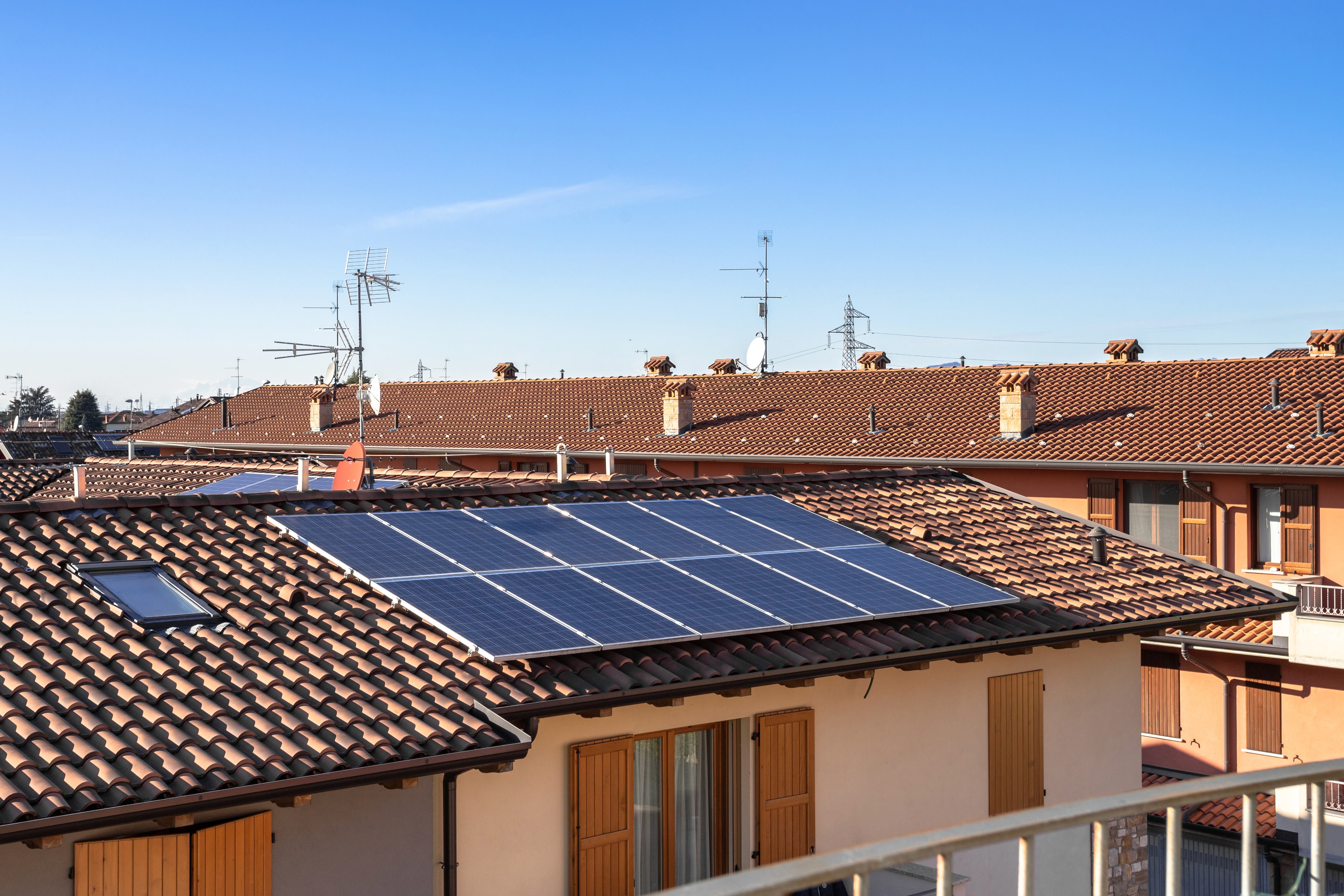
An off-grid solar PV system supplies a building or a specific load without relying on the public electricity grid as a backup. It is particularly suitable for remote homes, holiday cabins, agricultural buildings and garages where connecting to the grid would be difficult or disproportionately expensive.
The difference between an off-grid installation and a conventional residential solar system goes beyond the presence of a battery. In a grid-connected system, any shortfall can be drawn from the grid when solar generation is low and the battery cannot meet demand. In an off-grid system, the solar panels, inverter, battery and energy management system must support the expected loads on their own.
Correct sizing becomes even more important when the system also powers an EV charger. Lighting, CCTV and an electric gate may use relatively little energy, while a single EV charging session can require several kWh within a few hours. Increasing battery capacity alone is not enough: inverter output, battery discharge power, winter solar generation and the ability to modulate charging must all be assessed.
The European Commission’s PVGIS tool includes a calculator for stand-alone solar systems. It can compare installed PV capacity, battery size and daily consumption, and estimate how often the system may be unable to meet demand. It is a useful starting point, but it does not replace a site-specific electrical design or a compatibility assessment of the system components.
What is an off-grid solar PV system?
An off-grid solar PV system, also known as a stand-alone or islanded system, creates an independent local electricity network. The panels generate direct current, the inverter converts it into alternating current and establishes the voltage and frequency required by the connected loads. The battery stores energy that is not used immediately and makes it available when solar production is insufficient.
When the panels generate more power than the loads require, the surplus charges the battery. If the battery is already full and there is no grid to accept the excess, the inverter must curtail the usable solar output. If PV generation and stored energy cannot meet demand, the system must reduce selected loads, start a backup source or shut down in a controlled manner.
Battery capacity and power are not the same
Battery capacity, measured in kWh, indicates how much energy can be stored. Power, measured in kW, indicates how much energy the battery can deliver at a given moment.
A high-capacity battery with a low discharge rating may be unable to power an EV charger or several appliances at the same time. A smaller battery with a high power rating may handle a short peak but discharge quickly.
The inverter must also be selected according to continuous demand and the start-up peaks of pumps, motors and compressors. When the available power cannot support every load simultaneously, an energy management system must set priorities and prevent overloads.
Off-grid, grid-connected and backup systems: the differences
In a grid-connected system, the public network balances the difference between generation and consumption in real time. If the PV system produces 2 kW while the home requires 4 kW, the remaining 2 kW are drawn from the grid. When generation exceeds consumption, the surplus may be exported, depending on the system configuration and the rules in the relevant country. A grid-connected solar PV system therefore offers a level of continuity that an off-grid installation must provide entirely from its own resources.
A grid-connected system with battery storage saves part of the surplus for later use but can still draw electricity from the grid once the battery is depleted. It does not need to be designed to cover every night, occasional power peak or prolonged period of low solar generation independently.
Backup and EPS do not necessarily mean off-grid operation
A hybrid inverter may include a backup or Emergency Power Supply output designed to keep selected circuits running during a power cut. This does not automatically mean that the entire building can operate permanently without the grid.
The backup output rating, available phases, transfer time, black-start capability, PV operation during an outage and the circuits connected to the backup distribution board must all be checked. A system may keep a refrigerator, router and several lights running without being able to supply a cooker, heat pump and EV charger at the same time.
A zero-export installation is also still connected to the grid. It prevents surplus electricity from being exported but can draw power whenever the panels and battery are unable to meet demand. It is therefore not an off-grid system.
For a home that already has a grid connection, retaining it is often the most efficient option. A fully independent system makes most sense when the grid is unavailable, the connection requires expensive construction work or a remote load has predictable and controllable energy requirements.
How to size an off-grid solar PV system
Sizing must begin with actual consumption and the least favourable operating conditions. Replicating the configuration of a conventional home solar system with storage can result in an installation that fails precisely when energy is needed most.
1. Calculate daily energy demand
Start by listing every appliance and load, along with its rated power, operating time, frequency of use and seasonal pattern. Energy consumption can be estimated by multiplying power by operating time. For refrigerators, pumps and compressors, however, the real duty cycle must be considered rather than relying only on the nameplate rating.
The assessment should distinguish between:
essential loads, such as refrigeration, basic lighting, communications and security systems;
flexible loads, such as washing machines, water heaters and certain tools;
summer and winter consumption;
occasional loads;
energy required for the electric vehicle;
appliances that may operate simultaneously.
In an independent system, the EV charger should normally be treated as a flexible load. Its output can be reduced or charging can be paused to preserve energy for essential services.
2. Check simultaneous power demand
Daily kWh figures do not describe short-term power peaks. A home may consume 10 kWh over 24 hours but still require several kW for a few minutes when an induction hob, pump and other appliances operate together.
The inverter must support both continuous demand and temporary start-up peaks. The battery must also be able to supply the required current. If the system cannot support all devices at once, load management should prevent them from operating simultaneously.
A charger with adjustable output is particularly useful in this context. Temporarily reducing EV charging power is often more sensible than oversizing the entire installation for an avoidable peak.
3. Size the system for winter production
Annual solar yield does not provide enough information to assess off-grid reliability. A system may produce abundant energy between spring and early autumn but prove inadequate in winter. The design should consider the month with the lowest irradiation, seasonal shading, temperature, possible snow cover, higher winter consumption and several consecutive days of poor weather.
For an islanded installation, one of the most useful metrics is not simply total energy production but how often the system is expected to be unable to serve the load.
4. Define the required autonomy
The number of days the system must operate without significant solar generation has a direct impact on battery capacity. If essential loads consume 7 kWh per day and two days of autonomy are required, at least 14 kWh of usable storage will be needed, before accounting for system losses and a safety reserve.
Usable capacity is not always the same as nominal capacity. Part of the stored energy is normally reserved to protect the battery and maintain system stability. Daze’s guide to a solar PV system with battery storage explains the distinction between stored energy, available power and the role of the inverter. In an off-grid installation, these values must be assessed without assuming that the grid will cover any shortfall.
5. Balance panels, inverter and battery storage
A very large battery offers little benefit if the PV array cannot recharge it during critical periods. Conversely, a large array may generate substantial unused surplus in summer when the battery is already full.
The design must balance production during the least favourable months, usable storage capacity, battery charging rate, inverter power, available installation area and overall cost. For a permanently occupied home, combining an appropriately sized battery with an emergency power source may be more rational than sizing the battery for an extreme weather event.
Future loads should also be considered. Adding a heat pump, electric water heater or second EV can make a previously adequate system insufficient. Battery expandability, inverter limits, available MPPT inputs and possible future three-phase requirements should be evaluated from the outset.
Remote homes and garages: two different use cases
A home and a garage may both lack a grid connection, but their energy profiles and continuity requirements are very different.
Seasonal homes and holiday cabins
A second home used mainly in spring and summer is one of the most favourable off-grid applications. Solar generation is higher during the period of occupancy, while consumption may be limited to refrigeration, lighting, a water pump and small appliances.
Loads that remain active while the property is unoccupied must still be included, such as alarms, CCTV, routers, frost-protection equipment and remote monitoring. If the property is also used in winter, more PV capacity, additional storage or an alternative energy source may be required.
Permanently occupied homes
A fully independent home must cope with every combination of seasonal conditions and household consumption. A heat pump, induction hob, oven, electric water heater, well pump and electric vehicle can require substantial energy and high peak power.
A realistic operating strategy includes scheduling flexible loads during daylight hours, maintaining a minimum battery reserve, separating priority circuits and limiting non-essential demand automatically. Autonomy therefore depends on both system size and the household’s ability to adapt consumption to available energy.
Garages with lighting, gates and CCTV
An isolated garage that powers only auxiliary services has a lower and more predictable demand. The electric gate’s start-up current, the continuous consumption of surveillance equipment and the environmental conditions around the battery must still be assessed.
Any general-purpose socket should be protected or power-limited to prevent an unexpected high-load tool from draining the battery or overloading the inverter.
Garages with an EV charger
EV charging changes the scale of the installation. A charger operating at 3.7 kW for four hours theoretically requires 14.8 kWh before charging losses are included. This may be several times greater than the garage’s other daily energy needs.
Feasibility depends on daily mileage, vehicle consumption in kWh/100 km, whether the car is present during daylight hours, available roof area, winter output and access to an alternative charging point.
An off-grid garage can work well for a vehicle that covers relatively few kilometres and remains parked during the day. It becomes considerably more demanding when the vehicle returns only in the evening and must recover a large amount of range every night.
If the garage is close to the home, installing a dedicated cable from the existing electrical system may be simpler and more reliable. For a remote garage, an off-grid system may avoid trenching or the creation of a new grid connection. The financial comparison should include the panels, battery, inverter, installation and maintenance, as well as the actual cost of connecting the building to the grid.
Powering an EV charger with an off-grid solar system
On a local network created by an inverter, the EV charger must adapt to the power that is genuinely available. Its maximum rating does not indicate how much power it should draw at all times.
Calculate demand from daily mileage
The vehicle’s energy requirement should be based on real travel patterns. If an EV consumes 17 kWh/100 km and travels 40 km per day, it uses approximately 6.8 kWh from its traction battery. Once charging losses are included, the solar installation will need to supply slightly more.
The system does not necessarily need to be sized around the vehicle’s full battery capacity. In many cases, regularly replenishing the energy used for daily travel is a more realistic objective than providing a complete charge from empty.
Adjust charging power to available capacity
A 7.4 kW wallbox does not have to operate at full power. If the inverter can supply 6 kW and the home is currently using 2.5 kW, less than 3.5 kW remains available for the vehicle. Charging must be reduced before the inverter reaches its limit.
The inverter’s continuous and peak output, battery discharge power, single-phase or three-phase local network, minimum current accepted by the vehicle and communication between the charger, meter and Energy Management System must all be compatible.
Compatibility should never be assumed. It must be checked for the specific inverter, battery, EMS and EV charger by the system designer and the relevant manufacturers.
Prioritise daytime charging
The most efficient strategy is to use solar energy directly while it is being generated. This reduces the energy cycled through the stationary battery and preserves a reserve for overnight loads.
The same principle applies to charging an EV with solar power, but load priorities must be stricter in an off-grid system. If a cloud reduces PV output or an essential load starts operating, the charger must reduce its power or pause the session.
Solar charging and dynamic load management can help use the available surplus, but they cannot compensate for an undersized system. Operation on an islanded network must also be verified against the specific characteristics of the inverter, battery, EMS and charger.
Limit overnight charging
Charging at night uses energy stored in the stationary battery, increasing both the required capacity and the number of cycles. If the home needs 8 kWh overnight and the car requires another 7 kWh, at least 15 kWh of usable storage is needed, plus losses and a safety margin.
Where overnight charging is unavoidable, it is advisable to limit the charging rate, maintain a reserve for the home, define the minimum range required for the next journey and stop charging below a set battery state of charge.
Check single-phase and three-phase compatibility
The inverter must create the type of electrical supply required by the charger. A single-phase local network cannot provide three-phase charging at 11 kW. Even with a three-phase inverter, power per phase, phase balance and battery compatibility must be verified.
The charger should therefore be selected on the basis of the energy and power actually available, not simply its maximum rated output.
What happens when solar generation and the battery are not enough?
A properly designed system maintains a minimum reserve and assigns different priorities to its loads. Refrigeration, essential lighting, communications and security may remain active for longer, while the EV charger, climate control, tools and other flexible loads are limited first.
The EMS can progressively reduce consumption, pause EV charging and disconnect non-priority circuits. If the battery reaches its protection threshold, the inverter may shut down its output to avoid harmful over-discharge. The system can restart when solar production returns, a backup source becomes available or excessive loads are removed.
Backup generator
For a permanently occupied off-grid home, a generator may be more practical than an extremely large battery designed to cover every rare event. It can start automatically below a defined battery threshold, supply the loads or help recharge the battery.
Its output, voltage quality, inverter compatibility, fuel, noise, maintenance, emissions and expected frequency of use must all be considered. A generator should provide resilience during exceptional or prolonged conditions, not routinely compensate for an undersized solar installation.
Safety, installation and local requirements
Even without a public grid connection, the installation must be designed and installed by qualified professionals. Appropriate protection is required on the PV side, battery side and local AC network, together with correct management of earthing, neutral conductors, surge protection and residual-current protection.
The EV charger should have a dedicated circuit and protective devices compatible with the islanded network. The supply created by the inverter must allow all safety devices to operate correctly under every expected condition.
The battery must be installed in accordance with the manufacturer’s instructions, considering temperature, ventilation, humidity, flood risk, impact protection, access, weight and safety distances. A garage may be convenient, but it can also be exposed to heat, dust, water ingress and accidental damage.
The absence of a grid connection does not automatically remove planning, landscape or structural requirements. Roof-mounted panels, ground-mounted arrays, canopies and solar carports must be assessed according to the site, the proposed works and the rules in the country or municipality concerned.
Common off-grid sizing mistakes
Relying on summer production
A system with abundant output in July may be inadequate in December. For year-round use, the assessment must begin with the least favourable season.
Looking only at kWh
Battery capacity, battery discharge power and inverter output must be checked together.
Confusing autonomy with backup
An EPS output does not automatically allow an entire building to operate permanently without the grid.
Charging an EV without dynamic management
Uncoordinated charging can exceed the power available and shut down the inverter. The charger must be capable of reducing or suspending demand in response to priority loads.
Using the entire stationary battery for the car
The storage system should preserve a reserve for the home, safety systems and other essential services.
Adding new loads without recalculating the system
A heat pump, electric water heater, power tools or a second EV can completely change the energy profile and require the installation to be resized.
Frequently asked questions about off-grid solar PV systems
Can an off-grid solar system power an entire home?
Yes, but it must be sized for winter production, simultaneous loads and the required days of autonomy. A fully electric home may need a very large installation and an emergency power source.
Is a 10 kWh battery enough?
It depends on consumption, usable capacity and discharge power. It may be sufficient for a small holiday cabin but inadequate for a home with a heat pump or EV charger.
Can an EV charger be installed without a grid connection?
Yes, provided the inverter, battery, protection devices and EMS can supply and modulate the charging load. Compatibility between all components must be checked before installation.
Is it better to charge an EV during the day?
Generally, yes. Daytime charging uses solar energy directly and reduces the amount of energy that must pass through the stationary battery.
What happens when the battery is depleted?
Depending on the configuration, the system can reduce loads, pause EV charging, shut down safely or start an emergency power source.
Is a generator always required?
No. It can, however, be useful for a permanently occupied home or in regions that experience prolonged periods of low solar generation.
Is every hybrid inverter suitable for off-grid operation?
No. It must be designed to create and maintain a local network without a reference from the public grid and must be compatible with the battery and expected loads.
Is it worth disconnecting a home that already has a grid supply?
Not necessarily. Retaining the grid usually allows for a smaller battery, greater continuity and more flexible EV charging.
Can a garage with only a few panels charge an EV?
It may contribute to charging if the vehicle covers relatively few kilometres, is available during daylight hours and the charger can modulate its power. It may not provide complete year-round charging autonomy.
Who should design the system?
A qualified professional should assess consumption, peak loads, expected production, safety devices and compatibility between the panels, inverter, battery, EMS and EV charger.
An off-grid solar PV system is not simply a conventional home installation with a battery added. It is an independent electricity network that must generate, store and distribute energy without support from the public grid.
It is particularly suitable for remote buildings, seasonal homes, agricultural facilities and garages where a grid connection is difficult or too expensive. For a permanently occupied home, it requires a detailed assessment of winter generation, peak power and the required days of autonomy.
An EV charger can be integrated, but it should be treated as a flexible load. Charging during daylight hours, adjusting power dynamically and maintaining a reserve for essential services are fundamental. In many cases, the most realistic goal is not to recharge the vehicle fully every time, but to replenish the energy used for regular daily travel.
Purchase your EV Charger
Our expert will contact you to offer you the most suitable solution for you.