Sep 21, 2026
Balcony solar with battery storage: is it worth it?
How to assess solar generation, surplus energy, battery capacity, evening demand and potential savings before choosing a balcony solar system with storage.
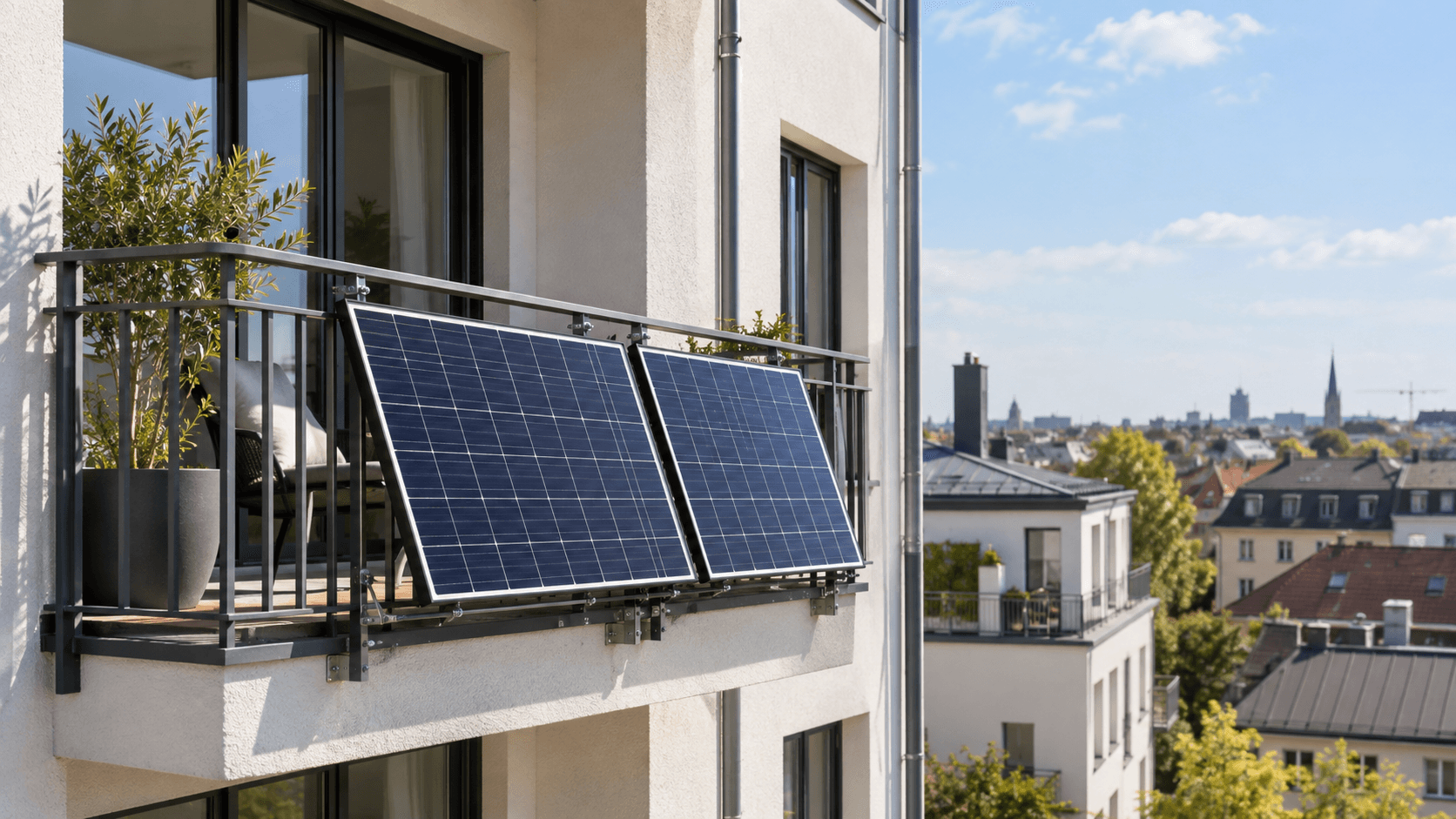
A small solar system installed on a balcony generates most of its electricity during daylight hours. The problem is that many people are at work, at school or otherwise away from home at precisely that time. The fridge, router and devices on standby continue to draw power, but they may not consume enough to use all the electricity available. This mismatch between solar generation and household demand explains the growing interest in balcony solar with battery storage.
A battery can store some of the electricity that is not used immediately and make it available later, for example in the evening. The idea is simple, but the financial case is not automatic. Storage does not increase the output of the panels, compensate for poor exposure or turn a small balcony kit into a system capable of covering all the electricity used by a home.
The most useful question is therefore not simply “how many kWh does the battery hold?”, but:
How much surplus electricity does the balcony system actually generate, and how much of it can the household use later?
A 4 kWh battery may look more attractive than a 1 kWh model. However, if the panels generate only a few hundred Wh of surplus electricity per day, much of that capacity will remain unused for long periods. The result may be a higher upfront cost, few equivalent full cycles and a very long payback period.
Before buying a kit with storage, four factors should be assessed:
the real output of the solar panels;
household consumption during solar hours;
the surplus available to charge the battery;
evening consumption that stored energy could replace.
Understanding how balcony solar systems perform, how they are installed and what affects their yield is the starting point. Adding a battery changes when the electricity is used, but it does not change the conditions in which the panels generate it.
What is a balcony solar system with battery storage?
A balcony solar system with storage is a small photovoltaic installation in which the electricity generated by one or more modules can either be used immediately in the home or stored temporarily in a battery.
A typical configuration may include:
one or more solar panels;
an energy controller or hub;
a battery;
a microinverter;
protection and connection devices;
a meter or monitoring system.
The exact configuration varies between products. In some systems, the battery is connected on the DC side before electricity is converted into alternating current. Other products manage storage on the AC side or use a proprietary architecture. There is therefore no single layout that applies to every kit.
How electricity moves through the system
During daylight hours, the panels generate direct current. The system manages this electricity according to household demand, the battery’s state of charge and the settings selected by the user.
The electricity can follow three main paths:
Direct self-consumption. The electricity is converted and used by appliances operating at that moment. This is normally the most efficient option because it avoids a complete charge-and-discharge cycle.
Battery charging. When generation exceeds the demand being covered by the balcony system, part of the surplus can be stored.
Deferred use. When solar output falls, the battery supplies electricity to the home within the system’s power and capacity limits.
The home normally remains connected to the grid. If the panels and battery cannot meet demand, the remaining electricity is imported from the grid as usual.
Storage does not create additional energy: it changes when part of the generated electricity is used. This distinction matters because the economic benefit of the battery must be separated from the savings generated by the panels themselves.
What happens when the battery is full or empty?
Once the battery reaches its upper state-of-charge limit, it cannot continue absorbing electricity. Depending on the product architecture, connection arrangements and system settings, the remaining generation may be used by active loads, limited by the controller or exported where this is permitted.
When the battery reaches its minimum state of charge, the system reduces or stops discharging to protect the cells. The home then resumes importing electricity from the grid.
A balcony battery does not make a home energy independent. Its main purpose is to increase the share of locally generated solar energy that is consumed on site. The choice between a solar PV system with or without storage follows the same basic logic in a conventional residential installation, but the relationship between generation and battery capacity is even more critical in a much smaller balcony system.
How much surplus electricity can a balcony system generate?
A battery can charge only when electricity remains after simultaneous household demand has been covered. Total panel output is therefore not the same as surplus generation.
If a balcony system generates 1.5 kWh in one day and the home directly consumes 1.2 kWh during the same hours, the theoretical energy available for storage is only 0.3 kWh. Selecting a 2 or 4 kWh battery on the basis of total generation would almost certainly oversize the system.
The effect of baseload consumption
Even an apparently empty home continues to consume electricity. Typical baseloads include:
fridges and freezers;
routers and network devices;
alarm systems;
ventilation equipment;
home automation;
appliances on standby;
small servers, aquariums or other continuous loads.
If these loads already absorb much of the solar output, little energy will remain for the battery. A constant 150 W load, for example, consumes 0.9 kWh over six hours. A small kit may therefore generate limited surplus electricity even on a sunny day.
A simplified calculation is:
daily surplus = balcony solar generation − direct consumption during the same hours
The calculation should be repeated over several days and, ideally, in different seasons.
Annual yield and hourly generation
Annual yield is useful when estimating the system’s overall contribution, but it is not enough to size a battery. Storage operates over much shorter periods. It is important to know when the panels start generating, when output peaks, how long the surplus lasts and how much electricity is still stored when the evening begins.
Two balconies with the same annual yield can produce very different results:
an east-facing balcony generates mainly in the morning;
a south-facing balcony generally concentrates more output around the middle of the day;
a west-facing balcony brings generation closer to late-afternoon and early-evening demand.
When generation already overlaps with household demand, direct self-consumption rises and the battery may add less value. If the home is empty during peak production, more surplus may be available for storage.
Panel angle and shading are equally important. A module mounted vertically on a railing does not operate under the same conditions as a panel installed at an optimised angle on a roof. An overhanging balcony, opaque railing, neighbouring building, tree or awning can significantly reduce the electricity available.
For an initial estimate, PVGIS, the European Commission Joint Research Centre’s official tool, can model solar radiation and PV performance by location and installation parameters. If the balcony system is already installed, however, its monitoring data provides an even more useful basis: actual measured generation.
Why summer output can be misleading
The battery may fill almost every day in summer but complete very few cycles in winter. Sizing it around the best day in June can leave a substantial share of its capacity unused for much of the year.
The most suitable battery is not necessarily the one that stores the most electricity. It is the one that can be charged and discharged reasonably often across the year.
How to choose battery capacity
Compact batteries for balcony solar systems are often available in capacities of around 1, 2 or more kWh. Capacity matters, but it should be considered alongside:
nominal and usable capacity;
charging power;
discharge power;
round-trip efficiency;
depth of discharge;
expansion options;
compatibility with the panels, controller and microinverter.
Nominal capacity describes the theoretical amount of energy stored in the battery. The system may reserve part of that capacity to protect the cells. Conversion losses also mean that the electricity delivered back to the home will be lower than the amount initially sent to the battery.
Capacity, inverter configuration, monitoring and control all affect how a battery storage system works. The same principles apply to balcony storage, but on a much smaller scale.
When approximately 1 kWh may be enough
A battery of around 1 kWh may suit:
a single panel or low-power kit;
limited daily surplus;
light evening loads;
the aim of covering lights, a router, a television and part of the baseload;
generation that varies significantly throughout the year.
This capacity is comparatively easy to fill. A small battery that completes more cycles may be used more effectively than a larger unit that frequently remains partly empty.
When approximately 2 kWh may make sense
A battery of around 2 kWh may be suitable when:
the system has several modules;
the balcony has favourable exposure;
daytime household demand is low;
surplus generation frequently exceeds 1 kWh;
evening demand is sufficient to use the stored electricity;
the battery can accept the available charging power.
This size provides more flexibility, but output must support it. A 2 kWh battery receiving an average of only 400 Wh per day will rarely be fully utilised.
When 4 kWh may be too much
A battery of around 4 kWh can be useful within a larger or expandable system. Paired with a balcony installation rated at only a few hundred watts, however, it may be significantly oversized.
Filling it requires more than 4 kWh of surplus once losses are considered. It is not enough for the panels to generate that amount in total: simultaneous household consumption must be deducted first.
The larger capacity may still be justified if the system will be expanded, the product can charge from another authorised source or it includes a specific backup use case. These situations should be verified rather than assumed.
Capacity and power are different
Capacity determines how much energy can be stored. Power determines how quickly energy can enter or leave the battery.
If the panels create a 700 W surplus but the battery accepts no more than 300 W, it cannot store the entire surplus at that moment. Similarly, a 2 kWh battery with an 800 W output limit cannot power a 2,000 W kettle by itself. Depending on the system, the battery may contribute while the grid supplies the remainder.
A practical sizing process is to:
estimate hourly solar generation;
measure direct daytime consumption;
calculate average surplus generation;
examine evening demand;
account for system losses;
choose usable capacity close to the energy that can realistically be transferred;
check charge and discharge power.
The battery should not be sized around the home’s total electricity use. It should be sized around the overlap between available surplus and demand that can be shifted to a later time.
What can a small balcony battery power?
A compact battery can cover a meaningful share of small evening loads, but it is unlikely to power every appliance in the home by itself.
Low and relatively steady loads are generally the best match. Routers, LED lighting and standby devices can operate for several hours without high power peaks. Televisions and laptops are also usually compatible because their demand is comparatively predictable.
A fridge can be partly or substantially covered, but the figure on its rating plate does not tell the full story. The compressor switches on and off, so daily energy use or measured evening consumption is more relevant than its instantaneous rated power.
Microwaves, kettles and hairdryers demand much more power, even when used for only a few minutes. The battery may contribute, but it may not be able to supply them alone. The grid will then provide the remaining power according to the system configuration.
Ovens, induction hobs and air-conditioning units are even less suited to a small balcony battery. Their demand can easily exceed the battery’s output, so the system should not be treated as a substitute for a full residential solar installation.
The same applies to an EV charger. The output and storage capacity of a balcony system are much lower than the energy required by an electric car, so it cannot be considered a dedicated source for vehicle charging.
A battery with 1 kWh of usable capacity could theoretically support an average load of 100 W for approximately ten hours. In practice, conversion losses and discharge limits reduce that figure. The same 1 kWh would last around two hours at 500 W and much less at 2 kW, assuming the battery can deliver that power at all.
When is balcony solar with battery storage worth it?
Storage tends to be most useful when solar generation and household demand occur at different times.
It is more likely to make sense when
the home is empty around the middle of the day;
the balcony has good solar exposure and little shading;
the system produces a regular surplus;
electricity use is concentrated in the late afternoon and evening;
battery capacity is proportionate to the surplus;
the cost of storage is reasonable compared with the savings available.
Someone who is away during the day, for example, may have only a fridge, router and standby loads running while the panels generate. If production exceeds those loads, stored electricity can cover part of the television, computer and lighting demand after they return home.
It is less likely to make sense when
very little surplus is generated;
the balcony is heavily shaded;
most solar electricity is already used directly during the day;
the selected battery is too large;
storage is particularly expensive;
the balcony system will soon be replaced by a conventional installation;
the buyer expects full energy independence or automatic backup.
Someone working from home may already consume much of the output through a computer, monitors, cooling and other appliances. In that case, less surplus remains for storage.
Shift demand before buying a battery
Before adding storage, it is worth checking whether some loads can be moved into solar hours. Depending on the appliance and safe operating conditions, examples include:
washing machines;
dishwashers;
device charging;
dehumidifiers;
programmable small appliances;
an electric water heater designed for controlled operation.
Direct self-consumption avoids the purchase cost of the battery, charge and discharge losses, cell degradation and eventual replacement.
A rational order of priorities is therefore:
increase direct self-consumption;
measure the remaining surplus;
choose a battery sized for the energy that cannot be used immediately.
Cost, savings and payback
The price of a balcony system with storage depends on panel count and power, battery capacity, controller, microinverter, smart meter, software, mounting hardware, protection devices, installation, warranty and expandability.
Two 2 kWh batteries may differ substantially in power, efficiency, compatibility, weather protection and warranty terms. Comparing products solely by price per kWh can therefore be misleading.
Solar battery storage prices vary with capacity, chemistry, compatibility, installation and the services included. Conventional residential batteries are usually much larger than the units considered for balcony systems, so figures should not be transferred directly from one category to the other.
Separate panel savings from battery savings
Suppose a balcony system generates 600 kWh per year. Without a battery, the home directly consumes 400 kWh. The remaining 200 kWh represents the theoretical annual surplus.
Storage will not necessarily recover all 200 kWh. Some may be generated when the battery is already full, some may exceed its charging power, and part will be lost during conversion and cycling.
Assume, purely as an illustration, that storage allows the household to use an additional 150 kWh. The battery’s financial benefit should be calculated using those 150 kWh, not the full 600 kWh generated by the panels.
A simplified formula is:
additional self-consumed electricity enabled by the battery × avoided retail electricity cost
If the battery makes 150 kWh available and the assumed avoided cost is €0.30/kWh:
150 × €0.30 = €45 per year
This is an example, not a universal forecast. The value of avoided electricity depends on the supply contract, tariff structure, taxes and country.
Estimate the payback period
Simple payback can be estimated by dividing the cost of storage by the additional annual savings.
If the battery costs €900 and saves €45 per year:
€900 ÷ €45 = 20 years
A fuller calculation should also account for degradation, expected service life, standby consumption, maintenance, future electricity prices, available incentives and residual value.
If the payback period exceeds the battery’s expected economic life, the system may be technically useful but financially unattractive.
Cycle count matters too. An oversized battery may complete few equivalent full cycles each year and transfer relatively little energy over its lifetime. A smaller unit charged and discharged regularly may be used more effectively.
Installation, compatibility and connection rules in Europe
The expression “plug and play” is widely used in marketing, but it does not have one uniform technical or legal meaning across Europe. Permitted inverter output, notification procedures, dedicated socket requirements, export rules and installer obligations vary by country and, in some cases, by distribution system operator.
EU legislation recognises the role of renewable self-consumers and establishes a common framework for producing and consuming renewable electricity. The consolidated EU Renewable Energy Directive, however, does not replace national electrical standards, building rules or grid-connection procedures for balcony systems.
Before buying or connecting a kit, the user should check:
the maximum output covered by simplified national rules;
whether the system must be registered or notified;
the requirements of the local distribution system operator;
whether a dedicated circuit or socket is required;
the permitted connection method and protection devices;
export metering and remuneration rules;
landlord, co-ownership or building requirements;
whether work by a qualified electrician is mandatory.
Output, connection method and documentation are therefore central when choosing plug-and-play solar panels. A product sold legally in one European country should not automatically be assumed to meet the connection requirements of another.
The battery must be compatible with the complete system
Panels, a battery and a microinverter should not be bought separately on the assumption that they will communicate and operate correctly together. The following must be checked:
voltage and current;
input and output power;
connectors;
controller requirements;
firmware and communication protocols;
software functions;
certification and conformity documentation;
warranty conditions.
Adding a battery to an existing kit is possible only if the architecture supports it. Before retrofitting storage, users should establish where the battery connects, whether the microinverter and controller are compatible, whether the warranty remains valid and whether the change affects registration or connection documentation.
“Ready to use” does not mean that every household socket is suitable. The electrical installation, circuit protection and connection point must comply with the requirements that apply in the country where the system is used.
Safety, outdoor installation and power cuts
Not every battery can be installed on a balcony. The selected location must comply with the manufacturer’s instructions, including:
permitted operating temperatures;
protection against water and dust;
direct sunlight and condensation limits;
ventilation requirements;
separation from combustible materials;
protection from impact;
weight and mounting stability.
An indoor battery should not be placed outdoors inside an improvised enclosure. Likewise, a rain-resistant product is not necessarily designed for prolonged direct sunlight or extreme temperatures.
Cables should not be trapped in doors or windows, left under tension, exposed to sharp edges or connected through unapproved adapters. If the battery swells, emits an unusual smell, becomes excessively hot, produces smoke or is physically damaged, it should no longer be used and the manufacturer’s safety instructions should be followed.
Will it work during a power cut?
Not necessarily. A grid-connected inverter must stop energising the grid when the mains supply fails. Simply adding a battery does not guarantee that household sockets will remain powered.
Providing electricity during an outage requires a system designed for that purpose, with features such as a dedicated backup output, an isolated circuit and controlled priority loads. This is the key difference between standard storage and a battery storage system with backup function.
The essential point is simple: storage and backup are not the same thing.
Can it charge an electric car?
A balcony system may make a small contribution to the home’s overall electricity demand, but it should not be presented as a dedicated source for an EV charger.
A 1 or 2 kWh storage unit is tiny compared with an electric vehicle battery. Balcony panel output is also low compared with the power used during a normal charging session.
Where household demand includes cooling, a heat pump or EV charging, a conventional residential installation is generally more appropriate. Solar generation, stationary storage, household loads and the EV charger can then be sized and managed as one coordinated energy system.
Four practical examples
A home that is empty during the day
The fridge, router and standby devices account for nearly all daytime use. The balcony has good exposure and produces a regular surplus around midday. In the evening, the household uses lighting, a television and a computer.
Storage may be useful because there is a clear gap between generation and demand. Capacity should still be based on average surplus rather than total evening consumption.
Someone working from home
A computer, monitors, cooling and small appliances are active while the panels generate. Direct self-consumption may already be high, leaving little electricity for the battery.
Using the solar output directly may be more economical than adding storage, or a very small battery may be sufficient.
A shaded or poorly exposed balcony
The panel generates little electricity and output is inconsistent. Adding a battery does not solve the problem because storage can preserve only the energy that actually exists.
Orientation, shading and real yield should be assessed first. Only then does it make sense to consider a battery.
A family with high evening consumption
Evening demand is substantial, but the balcony system generates only a limited amount of electricity. The battery may be emptied every evening without receiving enough surplus to fill during the day.
If the household uses 8 kWh after sunset but the balcony system creates only 1 kWh of surplus, an 8 kWh battery would be disproportionate. Surplus generation, not total demand, remains the correct reference.
Is it worth it? A six-step checklist
Before buying storage:
Estimate real generation, considering location, orientation, angle and shading.
Measure demand during solar hours, separating continuous baseloads from occasional appliance use.
Calculate the surplus by subtracting simultaneous direct consumption from generation.
Assess evening demand to determine how much stored electricity can actually be used.
Compare capacity and power, including usable capacity, charging limits, discharge limits and losses.
Calculate financial return, keeping battery savings separate from panel savings.
If surplus is frequent, evening demand is sufficient and payback is compatible with the battery’s expected life, storage may make sense. If one of these conditions is missing, a smaller battery or direct self-consumption alone may be the more rational choice.
Frequently asked questions about balcony solar with battery storage
Is balcony solar with battery storage always worth it?
No. It is most useful when the system regularly produces surplus electricity during the day and the home can use that energy later.
Can a 1 kWh battery be enough?
It may be enough for a small kit, limited surplus generation and light evening loads. The answer depends on usable capacity and actual output.
When should I consider a 2 kWh battery?
When the system frequently generates more than 1 kWh of surplus and the home can use that electricity after solar output falls.
Can a battery be added to an existing balcony solar kit?
Only if the microinverter, controller, connections and software are compatible. Warranty, conformity documentation and grid-registration implications should also be checked.
Does it work during a power cut?
Not automatically. The system needs a backup function or dedicated output designed to operate when the grid is unavailable.
Can the battery be installed outdoors?
Only if the manufacturer permits it and the location complies with the specified temperature, weather protection, ventilation and exposure limits.
Do balcony solar systems use the same connection rules across Europe?
No. Power limits, registration, sockets, protection devices and installer requirements vary between countries and distribution system operators.
Does plug and play mean the same thing everywhere in Europe?
No. It is a commercial description as well as a technical term, and its practical meaning depends on national standards and grid-connection rules.
When balcony solar with battery storage really makes sense
Balcony solar with battery storage can increase self-consumption when generation and household demand occur at different times. It is particularly relevant for people who are away during the day, have good solar exposure and use more electricity in the evening.
The battery must, however, be sized around real surplus generation: not the home’s total consumption, not the panels’ theoretical output and not the best summer day.
A small battery used regularly can be more rational than a high-capacity model that often remains partly empty. Before buying storage, it is worth increasing direct self-consumption where possible and measuring how much electricity genuinely remains available.
When selected using real data, installed in a compatible and compliant configuration and used within its limits, storage can help a household make better use of the solar energy generated on its balcony. It will not make the home independent from the grid, but it may reduce electricity imports and improve the value of a small solar system.
Purchase your EV Charger
Our expert will contact you to offer you the most suitable solution for you.